


Understanding and actively relieving buttock pain when sitting

If your buttocks hurt when sitting, it's usually not a coincidence. Often, it's a combination of sitting for too long, poor posture, and muscular imbalances. View the discomfort as a direct signal from your body that the strain on your gluteal muscles, pelvis, and lower back is too high.
Why Buttock Pain When Sitting Is a Warning Sign
Buttock pain is more than just a side effect of office life. It's a sign that your body is suffering from incorrect loading. Most of the time, it's not a single cause, but a chain of factors that reinforce each other and lead to pain.
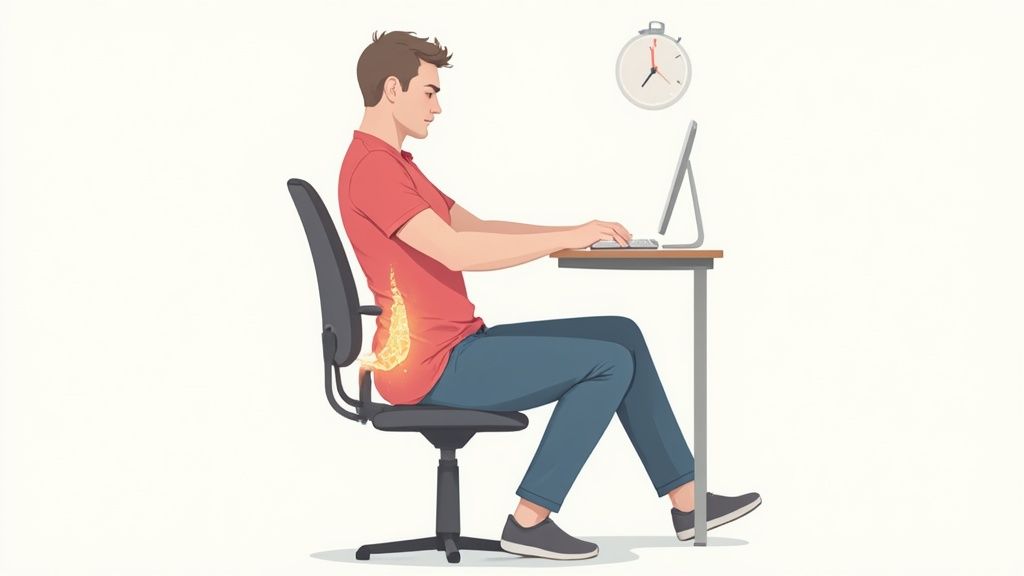
Modern work life forces many people into a passive, rigid sitting posture. This is not a feeling, but a fact: a study shows that 46 percent of Germans spend between five and eight hours sitting on a weekday. 21 percent even sit for nine hours or more. The consequences of prolonged sitting are varied and well-documented, as you can also read on liebscher-bracht.com.
This hours-long, often immobile position puts constant pressure on the gluteal muscles, sitting bones, and sensitive nerve pathways like the sciatic nerve. In the long run, this leads to tension, circulatory problems, and painful irritation.
Your body tries to compensate for an unhealthy sitting posture for a long time. The pain is the signal that these compensatory mechanisms are exhausted and a structural problem has arisen.
The Most Common Causes of Pain
The pain can originate from different structures. Understanding where the pain might be coming from is the first step towards improvement. Typical causes include:
- Muscular Tension: The large gluteal muscles (gluteal musculature) harden due to lack of movement and poor posture.
- Piriformis Syndrome: Here, a small muscle deep in the buttock (piriformis muscle) presses on the sciatic nerve. The result is pain that often radiates into the leg.
- Radiating Back Pain: Problems in the lumbar spine, such as herniated discs or blockages, can send pain signals directly to the buttock.
- Trigger Points: These are small muscle hardenings that, when pressed, trigger a sharp pain and can also radiate this pain to other areas of the body.
- Bursitis: Inflammation of the bursa over the sitting bones leads to a localized, unpleasant pressure pain.
The following table will help you better classify your symptoms and identify possible causes.
Overview of Common Causes of Buttock Pain
This table serves for quick identification of possible pain causes based on typical symptoms.
| Possible Cause | Typical Symptoms | Main Triggers |
|---|---|---|
| Muscular Tension | Dull, widespread pain in the buttock, often bilateral | Prolonged sitting, poor posture, lack of movement |
| Piriformis Syndrome | Deep, often unilateral pain that can radiate into the leg | Pressure on the sciatic nerve by the piriformis muscle |
| Herniated Disc (LSS) | Radiating pain, often associated with numbness or tingling | Pressure of the disc on a nerve root |
| Trigger Points | Localized, stabbing pain on pressure, can radiate | Local muscle hardenings due to overuse |
| Bursitis | Pain directly over the sitting bone, worse with direct pressure | Constant pressure on the sitting bones, e.g., on hard chairs |
This overview offers an initial orientation. In case of doubt, a precise diagnosis should always be made by a doctor or therapist.
Analyzing the Most Common Causes of Pain
To relieve your buttock pain when sitting, you need to know where it's coming from. Pain usually has a specific cause, located in the muscles, nerve pathways, or bone structures of your pelvis.
This knowledge is key to targeted countermeasures. It makes a difference whether a muscle is pressing on a nerve or if there is inflammation in the tissue.
Piriformis Syndrome as a Cause
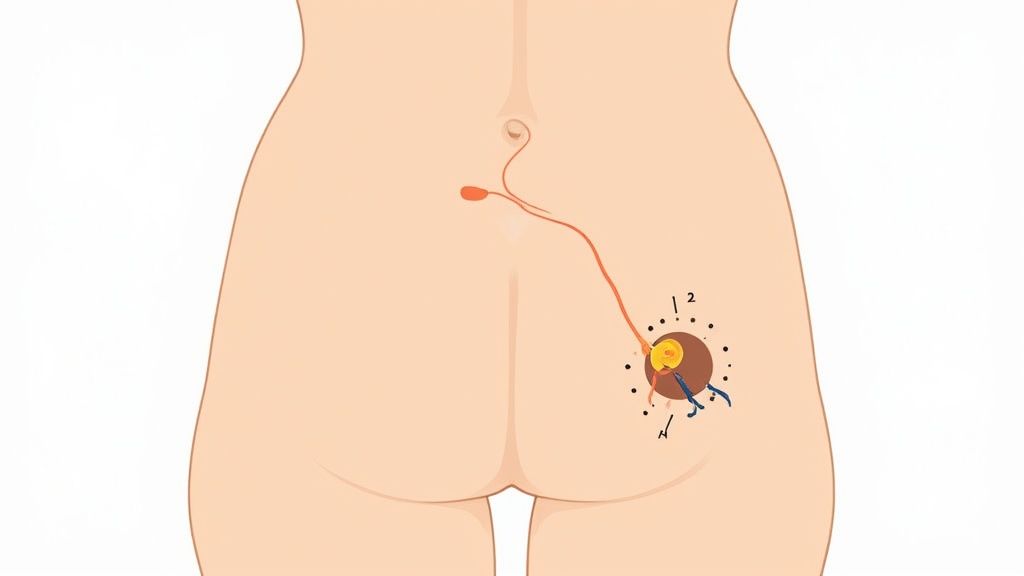
A common cause of deep buttock pain is Piriformis Syndrome. The piriformis is a small, pear-shaped muscle located beneath the large gluteal muscles. Its main function is external rotation of your thigh.
Its location is tricky. Directly beneath it or passing through it is the sciatic nerve, the thickest nerve in the body. If the piriformis muscle hardens and shortens due to prolonged sitting, overuse, or poor posture, it can exert direct pressure on this nerve.
Imagine the sciatic nerve as a data cable and the piriformis muscle as a clamp. As long as the clamp is loose, all signals flow unhindered. If the clamp tightens, it disrupts transmission and causes pain, tingling, or numbness along the nerve's path.
Typical signs of piriformis syndrome include:
- A deep, throbbing pain, usually on one side of the buttock.
- The pain worsens when sitting, climbing stairs, or walking.
- Sometimes the pain radiates down the back of the thigh into the calf.
Piriformis syndrome is a relevant cause. In Germany, it accounts for about 0.3 to 0.6 percent of all cases of lower back pain or sciatica. Compression of the sciatic nerve leads to unilateral buttock pain radiating into the leg. You can find more insights on this in this article about deep gluteal pain syndrome.
Radiating Pain from the Lower Back
Not all buttock pain originates there. Often, it's referred pain, with its source in the lumbar spine (LSS). Problems like herniated discs, spinal canal stenosis, or blockages of the facet joints can irritate the nerve roots that supply your buttocks and legs.
The pain feels like it's coming from the buttock, even though the problem is higher up. An indication of this is if the pain can be triggered by movements of your back, such as bending or twisting.
Myofascial Trigger Points in the Gluteal Muscles
Another common cause of buttock pain when sitting is myofascial trigger points. These are tiny, palpable knots or hardenings in the muscles. They arise from chronic overuse, poor posture, or stress.
These points not only cause localized pain but can also radiate pain to other areas. For example, a trigger point in the gluteus medius can cause pain that feels like sciatica. Direct pressure on such a point often triggers a sharp, recognizable pain.
Bursitis
Bursae are small, fluid-filled sacs that act as cushions between bones and soft tissues like muscles and tendons. There are several of them around the hip and buttock.
Bursitis occurs when these bursae become inflamed due to constant pressure or friction. This often happens due to:
- Prolonged sitting on hard surfaces.
- A fall on the hip.
- Monotonous movements such as prolonged running or cycling.
The pain from bursitis is usually very localized and can be felt directly over the greater trochanter (side hip bone) or the sitting bones. It worsens with direct pressure.
By observing the characteristics of your pain, you can better narrow down the most likely cause. This is the basis for finding suitable measures for relief.
Immediate Measures for Acute Pain Relief
When buttock pain suddenly occurs while sitting, you need quick help to break the pain cycle. This section is your emergency plan with measures you can implement immediately.
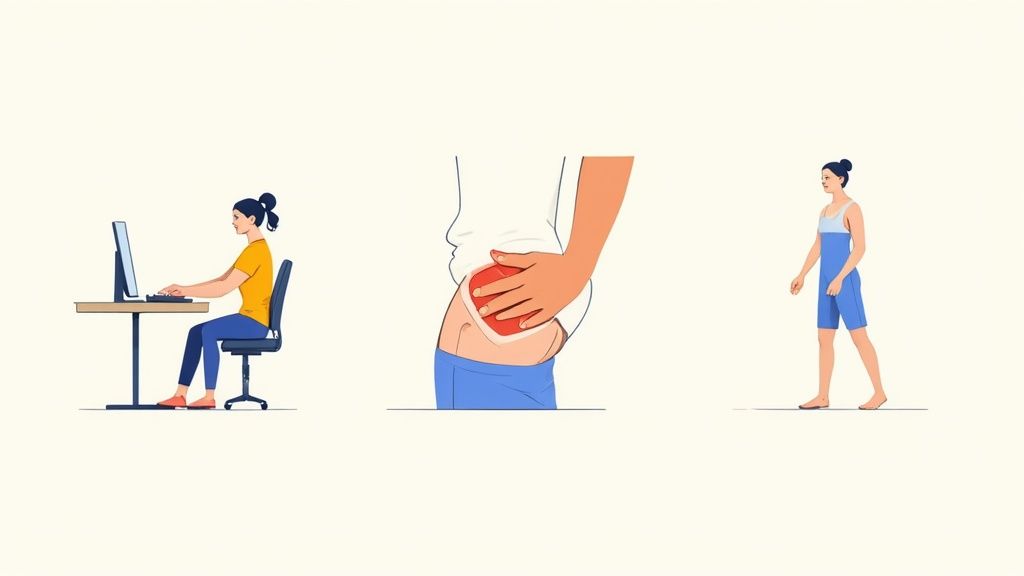
The first step is the most effective: take the pressure off the painful area. Stand up, walk a few steps, and give your buttocks a break from the chair.
Applying Heat or Cold Strategically
The answer to the question of heat or cold depends on the type of pain you have. Both can help if applied correctly.
- Heat helps with tense and hardened muscles. A hot water bottle, a cherry pit cushion, or a warm bath stimulates blood circulation. This loosens the muscles and speeds up the removal of metabolic products. Ideal for dull, pulling pain.
- Cold is the right choice for acute, stabbing pain that could indicate inflammation, such as bursitis. A cold pack (wrapped in a cloth) has an anti-inflammatory effect, constricts blood vessels, and numbs the pain locally.
This overview will help you make a decision.
Comparison of Heat and Cold Applications
| Application | Effect | Recommended for... | Application Duration |
|---|---|---|---|
| Heat | Muscle relaxing, circulation promoting | Chronic tension, dull muscle pain | 15–20 minutes |
| Cold | Anti-inflammatory, pain-relieving, decongestant | Acute inflammations, stabbing pain, bruises | 10–15 minutes |
Treat the affected area several times a day, but always give your skin a break in between.
Pressure Relief Through the Right Position
If you have to sit down again, consciously shift your weight to the pain-free side of your buttocks or lean slightly forward. This takes the pressure off the sitting bones.
An effective method for immediate relief is the supine hip flexion position. Lie flat on your back and place your lower legs at a right angle on a chair or a stack of pillows. This position relaxes the lower back and pelvic muscles and takes pressure off the buttocks.
Gentle Stretching Exercises at Your Desk
Light movement is often better than complete rest for tension. Gentle stretches can release stuck fascia and make tense muscles supple.
Here's a simple exercise:
- Sit upright on the front edge of your chair.
- Place the ankle of the painful leg over the knee of the other leg.
- Slowly lean your upper body forward with a straight back until you feel a stretch in your glutes.
- Hold this position for 20–30 seconds and breathe deeply. Then switch sides.
This exercise directly targets the piriformis muscle, a common cause of buttock pain when sitting. You can find many more exercises in our guide on lower back stretching, as these complaints are often related.
Important for all exercises: Only stretch as far as it feels good. The pain should not worsen. It's about gentle relief, not performance.
Movement Breaks as Pain Prevention
The best strategy against pain from sitting is to interrupt sitting regularly. Incorporate short movement breaks into your workday.
- Stand for phone calls: Use every phone call to stand up and walk around.
- The "Pomodoro Trick": Set a timer for 25 minutes. After each work period, take a five-minute break to stretch.
- Stairs instead of elevator: Every step is a small exercise program.
These small habits add up over the day. They prevent muscles from hardening and too much pressure building up on your buttocks.
Targeted Exercises for Sustainable Pain Relief
Immediate measures provide a temporary break. However, for sustainable improvement of your buttock pain while sitting, you need to take active steps. It's about addressing muscular imbalances in a targeted way.
Due to one-sided stress, your muscle system becomes unbalanced. Some muscles shorten, while their antagonists weaken. With targeted stretching and strengthening exercises, you restore this balance and make your body more resilient.
Stretching Exercises to Relieve Tension
Tense muscles are often the main reason for buttock pain. Regular stretching restores their flexibility and promotes blood circulation. Perform the exercises slowly and in a controlled manner.
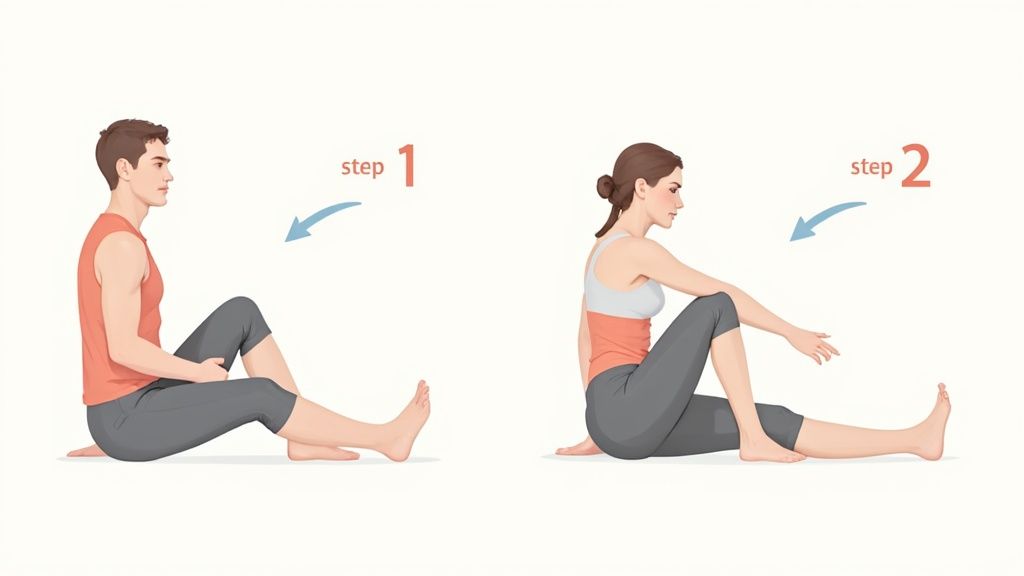
1. Seated Piriformis Stretch
You already know this exercise. It is very effective and should be an integral part of your program.
- Sit upright on a chair.
- Place the outer ankle of the painful leg on the knee of the other.
- Slowly lean your upper body forward with a straight back until you feel a distinct stretch in your glutes.
- Hold the position for 30 seconds and then switch sides.
2. Kneeling Hip Flexor Stretch
A shortened hip flexor tilts the pelvis forward and increases pressure on the lower back and glutes.
- Take a large lunge forward. Place the back knee on the floor.
- Slowly push your hip forward until you feel the stretch in the front of the hip of the back leg.
- Hold the stretch for 30 seconds per side. Make sure your upper body is upright.
Consistency is crucial. Schedule fixed times for your exercises, several times a week. Even 10 to 15 minutes per session can make a big difference.
Strengthening Exercises for More Stability
Weak gluteal and core muscles cannot properly stabilize the pelvis. This leads to poor posture and increased pressure when sitting. With targeted strengthening, you build a strong muscular foundation.
Strong gluteal muscles are fundamental for good posture and relieving the lower back. For lasting pain relief, targeted exercises for strong glutes are therefore essential, as strong gluteal muscles significantly improve posture and reduce pressure when sitting.
1. The Bridge (Glute Bridge)
This exercise specifically strengthens the large gluteal muscles and the hamstrings.
- Lie on your back, place your feet hip-width apart, and bend your knees. Your arms are at your sides.
- Slowly lift your pelvis until your body forms a straight line from your shoulders to your knees.
- Squeeze your glutes tightly. Hold the position briefly and slowly lower your pelvis back down.
- Perform 3 sets of 15 repetitions each.
2. The Plank
The plank strengthens the entire core musculature, which is indispensable for a stable spine.
- Start on all fours and place your forearms parallel on the floor.
- Extend your legs backward and rest on your toes. Your body should form a straight line from your head to your heels.
- Tighten your abs and glutes, without letting your back sag.
- Hold the position for as long as you can, for example, 3 sets of 30–60 seconds.
Your Weekly Training Plan
A structured plan helps you stay on track. Here is a simple suggestion for integrating the exercises into your week.
| Day | Exercise Program (approx. 15 minutes) |
|---|---|
| Monday | Stretching: Piriformis & Hip Flexor, Strengthening: Bridge |
| Wednesday | Stretching: Piriformis & Hip Flexor, Strengthening: Plank |
| Friday | Stretching: Piriformis & Hip Flexor, Strengthening: Bridge & Plank |
This routine is a good starting point that you can adapt to your needs. The mixture of loosening and strengthening is important. Additional tips can be found in our article on effective exercises for the lower back, as these areas are closely related.
The numbers speak a clear language: back and buttock pain are widespread in Germany. According to an AOK study, in 2021, 26.2 million people (31.4% of the population) suffered from medically documented back pain. At the same time, 61 percent of Germans state that they sit too much in their daily lives. You can read more about these correlations in the results of the AOK back study.
Ergonomically Furnishing Your Workspace
Your workplace should promote your health, not cause buttock pain when sitting. Ergonomic furnishing is a necessity for pain-free and productive work. With the right adjustments, you can transform your desk from a source of pain into a zone of well-being.
Often, it's small, conscious changes to your chair, desk, and monitor that have a big impact. The goal is a neutral and supportive posture that relieves pressure on your buttocks and lower back.
Proper Adjustment of Your Office Chair
Your office chair is the foundation of your sitting posture. If it's incorrectly adjusted, it forces your body into an unnatural position. The pressure on your sitting bones and lumbar spine increases. Take your time to make optimal adjustments.
Here is a checklist:
- Seat Height: Adjust the height so that your feet are flat on the floor. Your knees should form an angle of about 90 degrees, with your thighs sloping slightly downward.
- Seat Depth: Slide your buttocks all the way back. There should be two to three fingers' width of space between the back of your knees and the front edge of the seat.
- Backrest: The curve of the backrest (lumbar support) must support your lower spine in its natural S-shape. Adjust the height until the support sits in the curve of your lower back.
- Armrests: Position the armrests so that your shoulders remain relaxed and your forearms rest loosely at a 90-degree angle.
These settings relieve your buttocks and prevent tension in your neck and shoulder area.
Optimizing Desk Height and Monitor Position
After the chair, it's the desk's turn. The ideal height is reached when your forearms rest horizontally on the tabletop with relaxed shoulders. This is where height-adjustable desks show their strength.
Dynamic sitting is the key to prevention. This refers to alternating between different postures. A height-adjustable desk allows for an easy transition from sitting to standing and reduces static load on your buttocks.
The position of your monitor is also crucial. The top line on the screen should be at or just below your eye level. This prevents an unhealthy head posture. The distance to the screen should be about an arm's length.
Useful Accessories for Pressure Relief
Sometimes standard settings are not enough. In such cases, accessories can help distribute pressure better and correct posture.
- Ergonomic Seat Cushions: A good cushion can reduce pressure on the sitting bones and tailbone. Wedge cushions help to straighten the pelvis, while cushions with tailbone cutouts relieve this area.
- Lumbar Supports: If your office chair does not have good support for the lower back, an external lumbar support can maintain the natural curve of your spine.
- Footrests: If your feet don't reach the floor flat even at the lowest chair setting, a footrest provides stability and takes pressure off your thighs.
These aids are supplements, not a substitute for an ergonomic working method. The combination of correct adjustment, posture changes, and targeted accessories is the most effective way to avoid buttock pain while sitting. Detailed instructions can be found in our guide on how to set up your workspace ergonomically.
When You Should Seek Medical Help
Self-help and ergonomic adjustments are good tools for treating buttock pain when sitting. However, sometimes they are not enough. It is important to recognize when the pain is not just tension, but a warning sign of a more serious problem.
Certain symptoms should not be ignored, as they may indicate damage to nerves or other structures. In such cases, prompt action is required.
Warning Signs for a Doctor's Visit
Do not hesitate to seek medical help if your buttock pain is accompanied by any of the following warning signs. These "red flags" indicate causes that require immediate clarification.
- Numbness or Tingling: If your buttocks, genital area, or the insides of your thighs feel numb or tingle, this is an alarm signal.
- Sudden Muscle Weakness: If you have difficulty lifting your foot or a leg feels weak, this could indicate a pinched nerve root.
- Loss of Bladder or Bowel Control: Any form of sudden incontinence is a medical emergency.
- Severe Pain After an Accident: After a fall, you should always have pain checked to rule out fractures.
- Fever and Chills: If these symptoms accompany the pain, an infection could be behind it.
If any of these points apply to you, do not wait. Go directly to your family doctor or an emergency room.
The Right Contacts
Your first port of call is usually your general practitioner. They can assess the situation and, if necessary, refer you to a specialist.
Depending on the suspicion, different specialists may be involved. An orthopedist is the expert for the musculoskeletal system. A neurologist is consulted if there is a suspicion that the pain originates from the nerves, as in the case of a herniated disc.
To make an accurate diagnosis, there are various ways. In addition to a physical examination, imaging procedures such as an MRI (magnetic resonance imaging) are often crucial. This examination makes soft tissues such as intervertebral discs, muscles, and nerves visible and helps to find the exact cause of the pain.
FAQ: Quick Answers to Buttock Pain
Here you will find answers to frequently asked questions about buttock pain when sitting.
Can the wrong office chair be the cause?
Yes, an unsuitable chair is one of the most common causes. If it doesn't provide good support, has a hard seat, or forces you into a hunched posture, pressure on the sitting bones and sciatic nerve increases. Adjusting the chair ergonomically or replacing it is often the first step towards improvement.
What role does stress play in buttock pain?
Stress can intensify pain. Under tension, we unconsciously tend to tense our muscles, especially in the back, pelvis, and buttocks. This tension can create painful trigger points or worsen existing problems like piriformis syndrome. Relaxation exercises are therefore a useful addition to physical treatment.
Stress often manifests physically. Persistent muscle tension in the gluteal and pelvic area is a typical reaction to psychological stress and can trigger or intensify pain.
Do seat cushions help with buttock pain?
Ergonomic seat cushions can provide relief because they distribute pressure better. Wedge-shaped cushions help to straighten the pelvis, while cushions with coccyx cutouts relieve this area. However, they are not a panacea and work best in combination with movement and an ergonomic workspace.
Should I continue to exercise if I have buttock pain?
Movement is fundamentally important. If the pain is acute and severe, you should take a break and focus on gentle mobilization and stretching exercises. Avoid anything that directly provokes the pain, such as intense jogging or cycling. Once the acute phase is over, a targeted strengthening program for the core and glutes is ideal for preventing recurrence.
Transform your workplace into a pain-free zone. Deskspace's ergonomic solutions support you in working healthily and productively. Discover our height-adjustable desks and ergonomic chairs now. Find the perfect ergonomic solution at deskspace.de.


