


Ergonomic Office Chairs on Test: The Most Important Factors for Your Choice

Anyone who conducts an ergonomic office chair test quickly realizes: Good models combine synchro-mechanism, seat depth adjustment, and an adaptable lumbar support. A chair is only ergonomic if it can be precisely adjusted to your body measurements and actively promotes dynamic sitting.
What Makes a Good Ergonomic Office Chair
An ergonomic office chair is more than just a seat. It's a tool that actively protects your health and helps you stay focused. The core principle is simple: the chair adapts to your body, not the other way around.
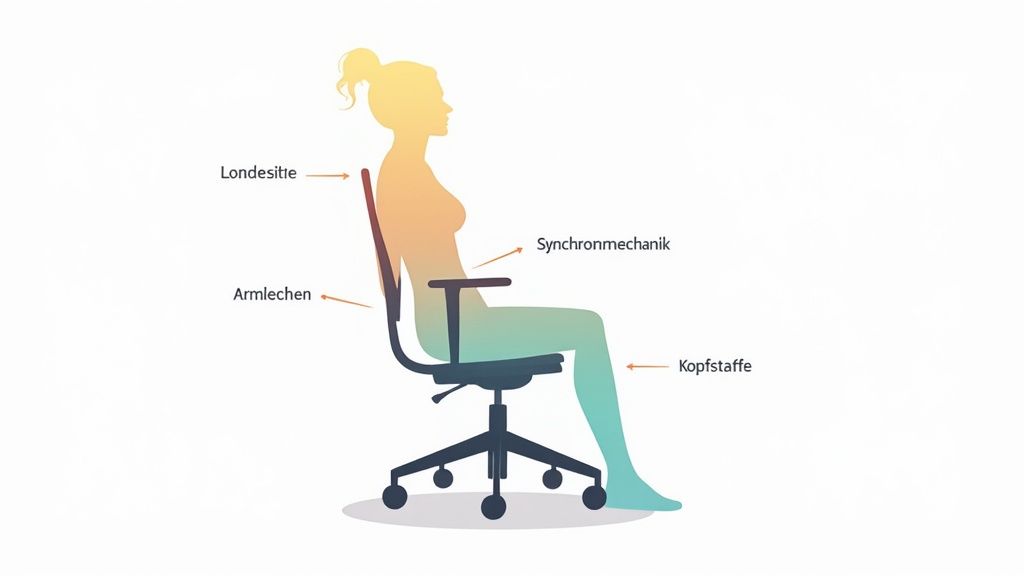
Current figures show how important this adaptability is. Back pain is widespread. At the beginning of 2020, almost 60% of all employees in Germany reported suffering from back-related complaints. Ergonomically designed workplaces have been shown to increase productivity by around 17.5%. More facts can be found in this article on flexispot.de.
The Key Components of Ergonomics
A chair becomes ergonomic through the interaction of several core functions. These elements are crucial for a healthy posture and prevent tension. Without them, active, healthy sitting is hardly possible.
Three functions are particularly important:
- Synchro-mechanism: This links the movement of the seat to that of the backrest. When you lean back, the angle between your torso and thighs remains constant. This relieves pressure on the intervertebral discs.
- Lumbar support: This curve in the lower part of the backrest supports the natural S-curve of your lumbar spine. Good lumbar support is adjustable in height and depth.
- Seat depth adjustment: This allows you to adjust the length of the seat to your thighs. Optimal is a distance of two to three fingers between the back of your knee and the edge of the seat.
An ergonomic office chair promotes movement instead of preventing it. It supports the body in every posture and encourages changes in position. This is crucial for the nutrient supply to the intervertebral discs.
Overview of Key Ergonomic Functions
A good ergonomic chair is a modular system of several important functions. Each one serves a specific purpose to optimally support your body and prevent health problems.
The following table summarizes the most important functions that an ergonomic office chair should possess.
| Function | Description | Health Benefit |
|---|---|---|
| Synchro-mechanism | Coupled tilt of seat and backrest. | Promotes dynamic sitting, relieves intervertebral discs. |
| Lumbar support | Adjustable support for the lumbar region. | Supports the natural S-shape of the spine. |
| Seat depth adjustment | Adjustable length of the seat. | Improves blood circulation in the legs. |
| Armrests | Adjustable in at least height and width. | Relieves shoulder and neck muscles. |
| Seat height adjustment | Adjustment of seat height to body size. | Ensures correct leg and foot posture. |
These functions only work when used correctly. Proper adjustment is the key to maximum health benefits.
In our guide, we show you how to adjust your office chair ergonomically.
The Most Important Test Criteria for an Objective Comparison
A good ergonomic office chair test requires clear, understandable criteria. To distinguish marketing claims from genuine quality, a systematic approach is necessary. A well-founded comparison is divided into four crucial categories.

You can use this method yourself to compare different models fairly and fact-based. This quickly reveals weaknesses and helps you make a well-informed purchasing decision.
Ergonomics and Adjustability
Adjustability is the heart of every ergonomic office chair. A chair can only demonstrate its strengths if it can be precisely adjusted to your individual body measurements.
Carefully check the following adjustment options:
- Seat height: Can the height be adjusted so that your feet are flat on the floor and your knees form a relaxed 90-degree angle?
- Seat depth: Can you move the seat so that there are two to three finger widths of space between the back of your knee and the front edge? This is crucial for blood circulation.
- Lumbar support: Is the curve in the lumbar region adjustable in height and depth? Only then will it support your spine where you need it.
- Armrests: Are the armrests adjustable in at least height and width (3D armrests)? Swiveling and depth-adjustable 4D armrests are ideal for relieving strain on the shoulders.
A chair without the right adjustment options forces your body into an unhealthy posture. This leads to tension and pain in the long run.
Also pay attention to the operation. The levers and buttons must be intuitively accessible and easy to move. A complicated mechanism that you never use offers no benefit.
Material Quality and Workmanship
The lifespan of an office chair directly depends on the materials used and their workmanship. This is often where quality separates from the mass. Take your time for a detailed inspection.
Pay attention to these details:
- Covers: Are the seams clean and straight? Does the fabric or mesh feel robust and abrasion-resistant? Cheap materials often show signs of wear quickly.
- Padding: Does the seat padding yield to pressure and spring back immediately? High-quality molded foam retains its supportive effect for years. Cheap foam quickly becomes saggy.
- Mechanical parts: Do plastic parts feel valuable and stable, or do they seem brittle? Sharp edges or burrs are typical signs of shoddy production.
Clean workmanship is usually a guarantee for the quality of the entire chair. Defects often indicate hidden weaknesses in the construction.
Stability and Load Capacity
An office chair must always give you a feeling of security, whether you are leaning back or moving. Stability is a critical safety feature.
Perform a simple practical test. Sit on the chair and consciously move back and forth.
- Does the base wobble or give way?
- Does the backrest have unwanted play?
- Does the mechanism creak or squeak when moving?
The gas lift for height adjustment is a central component. It should react smoothly and reliably maintain the height. Sudden sinking is unacceptable.
Another important criterion is the maximum load capacity. This should be significantly higher than your body weight to provide a safety reserve. High-quality chairs are often designed for up to 150 kg or more, which speaks for a robust construction. Learn more in our article about the different types of desk chairs and their selection criteria.
The Integrated Mechanics
The mechanics determine how well the chair supports your movements. The synchro-mechanism is considered the gold standard, as it best promotes dynamic sitting.
When testing the mechanism, check the following points:
| Test Criterion | Description of Action | Desired Result |
|---|---|---|
| Movement Sequence | Lean back slowly and then forward again. | The movement should be fluid and without jerking. |
| Counter-pressure | Adjust the resistance of the backrest. | The counter-pressure must be finely adjustable to your body weight. |
| Locking | Fix the backrest in different positions. | The locking mechanism must audibly engage and hold firmly. |
The mechanics should operate quietly. Loud noises with every movement disturb concentration and are often a sign of inferior construction.
Interpreting Test Results and Standards like DIN EN 1335 Correctly
In search of the right office chair, you will find many test seals, standards, and certificates. They are intended to provide guidance but often cause confusion. To assess the quality of a chair, you need to understand what lies behind these labels.
Only then can you critically question the results of an ergonomic office chair test and make a fact-based decision.
The Meaning of Common Test Seals
On the German market, there are various seals intended to certify safety and ergonomics. Each has its own focus and varying degrees of significance.
The three most important labels are:
- GS Mark (Geprüfte Sicherheit - Tested Safety): This seal confirms that a product meets the requirements of the German Product Safety Act (ProdSG). It primarily concerns safety: stability, load capacity, and the exclusion of harmful materials.
- TÜV Certificate: A TÜV seal often additionally evaluates ergonomic properties, absence of harmful substances, or manufacturing quality. The test criteria vary depending on the certificate. It's worth looking at the test report.
- IGR Seal (Interessengemeinschaft der Rückenschullehrer/innen e.V. - Community of Back School Teachers): This seal focuses on ergonomics. A chair with an IGR certificate has been classified by experts as back-friendly. Criteria include promoting dynamic sitting and comprehensive adjustability.
These seals offer good initial guidance. They confirm that a chair meets basic standards, but they do not replace personal testing.
What the DIN EN 1335 Standard States
DIN EN 1335 is a European standard that defines minimum dimensions and safety requirements for office work chairs. It specifies requirements for aspects such as seat height, seat depth, and the dimensions of armrests and backrests.
A chair that meets this standard is generally suitable for a large portion of the European population (approx. 90%). It provides a solid basis for adjustability and safety.
DIN EN 1335 is a solid minimum standard, but not a guarantee for perfect, individual ergonomics. It ensures that a chair fits most people, but does not take into account specific body measurements.
The standard alone reveals nothing about the quality of the mechanics or long-term comfort. A chair can meet the standard and still have a cheap synchro-mechanism or inferior padding.
The Limitations of Standards and Test Results
Standards and standardized tests can only partially reflect reality. They create a basis for comparison, but you should view the results with some distance.
A good example is Stiftung Warentest. In a test of nine office chairs, no model received a "very good" rating. A frequent criticism was stability. Such results influence purchasing decisions and underscore the importance of independent testing. You can read more about the relevance of the DIN standard on aeris.de.
To correctly classify test results, pay attention to these points:
- Analyze the testing methodology: Look closely at what and how it was tested. Was it only about tipping safety, or also about long-term comfort and the quality of the mechanics?
- Weighting of criteria: Does the weighting in the test match your priorities? If you value excellent lumbar support, but a test barely mentions this point, the result has less significance for you.
- Individual fit: No standardized test can assess whether a chair perfectly suits your body and sitting habits. A test winner can be a bad choice for you personally.
Standards and tests are important tools. However, the crucial test is the personal practical test in your own working environment.
Which Office Chair Suits Your Usage Profile
The best ergonomic office chair is the one that perfectly suits you and your daily work routine. There is no single best model for everyone. The right choice depends on how you use your chair daily.
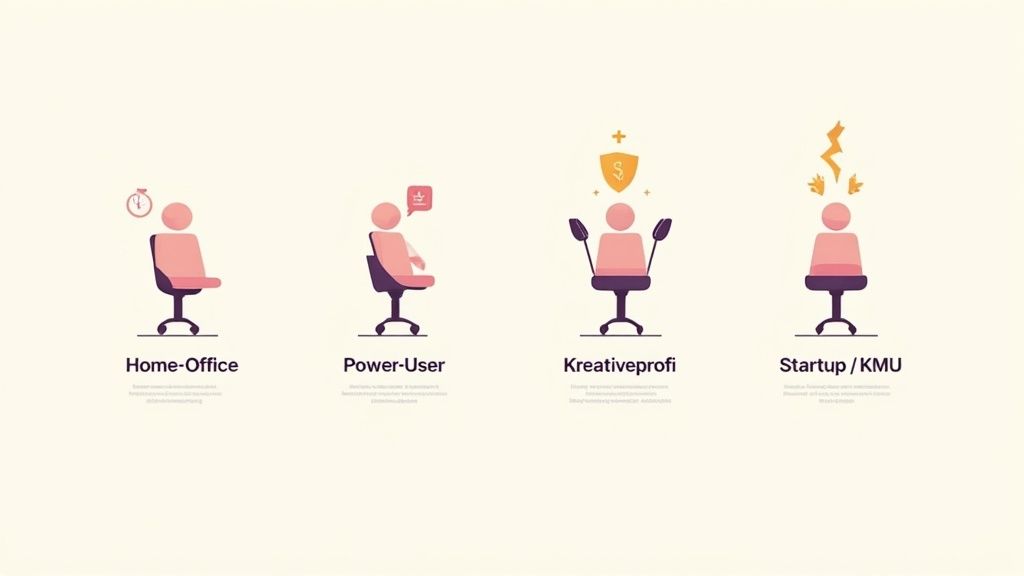
A power user in a home office has different demands than a startup. A creative professional pays attention to details that are trivial to others. The first step is to accurately know your own usage profile.
The Home Office Power User
Those who work as power users in a home office often spend eight hours or more at their desk. The office chair is the most important tool here. It must meet the highest ergonomic standards and visually blend into the living space.
Your priorities are on the following points:
- Maximum Ergonomics: First-class synchro-mechanism, precisely adjustable lumbar support, and 4D armrests are non-negotiable. The chair must actively promote dynamic sitting.
- High Seating Comfort: Padding that supports even after many hours is crucial. Breathable covers like mesh prevent sweating during long working days.
- Design and Aesthetics: The chair is part of your home, and its appearance plays a major role. It must harmoniously fit into your decor.
- Durability: You are investing in a tool for the coming years. Robust materials and impeccable workmanship are essential.
For you as a power user, the chair is an investment in your health and productivity. Compromises on core functions are out of place here.
SMEs and Startups
When small and medium-sized enterprises (SMEs) or startups furnish offices, functionality is paramount. The chairs must fit many employees, be durable, and offer good value for money.
The central requirements for this group are:
- Universal Adjustability: The chairs must be quickly adaptable to different body sizes and weight classes. A wide range of adjustment is crucial.
- Robustness and Durability: In daily office life, the chairs must withstand a lot and still look good after years. A sturdy metal base is often a better choice than plastic.
- Service and Warranty: A reliable partner is important. Short delivery times, uncomplicated warranty processing, and the possibility to reorder models are decisive factors.
- Price-Performance Ratio: The budget plays a major role. A solution that meets high ergonomic standards without breaking the bank is sought.
Cost-effectiveness is a key factor. A durable, ergonomic chair reduces illness-related absences and increases team satisfaction.
Creators and Tech-Pros
Creative professionals and developers also spend a lot of time at their desks. Their focus is often on a perfectly coordinated overall setup. Here, aesthetics, functionality, and technical details go hand in hand.
The following criteria are important for this target group:
- Setup Aesthetics: The office chair is a central design element of the workspace. It must visually match the rest of the equipment. Clean lines, high-quality materials, and matching colors are often decisive for purchase.
- Noise Level: A squeaking or creaking chair disturbs concentration. The mechanics and casters must work silently.
- Load Capacity and Stability: An elaborate setup requires a chair that can handle every movement without wobbling. A high load capacity of up to 150 kg or more provides additional safety.
- Freedom of Movement: Creative processes require changing sitting postures. The chair must allow maximum freedom and optimally support the user in every position.
An ergonomic office chair test for this target group should also consider criteria such as the smooth running of the casters and the noise development of the mechanism.
Requirement Comparison for Different User Types
The different priorities become clear in a direct comparison. The following table helps you classify your own requirements.
Requirement Comparison for Different User Types
This table compares the requirements of home office users, SMEs, and creative professionals for an ergonomic office chair.
| Criterion | Home Office Power User | SMEs & Startups | Creators & Tech-Pros |
|---|---|---|---|
| Ergonomics | Maximum, uncompromising | High standard, universal | High, for dynamic postures |
| Durability | Very high | Very high, for continuous use | High, focus on mechanics |
| Aesthetics | Important, suitable for living spaces | Functional, uniform | Very important, part of the setup |
| Price-Performance | Important, but secondary | Very important, decisive | Important, but quality counts |
| Noise Level | Important | Desirable | Very important, critical |
| Service | Desirable | Very important, partnership-based | Important, for accessories & warranty |
There isn't one perfect chair, but only the perfect chair for a specific requirement. By knowing your priorities, you'll find the model that best supports you at work.
How to Keep Your Chair Fit for a Long Time: Care and Maintenance
A high-quality ergonomic office chair is an investment in your health. To ensure it lasts for years, proper care and regular maintenance are essential.
More and more people recognize this value. By 2025, the revenue from ergonomic office chairs in Germany is estimated to be around 376.70 million Euros. By 2030, this value is expected to rise to approximately 445.32 million Euros. This growth shows: awareness of workplace health drives demand. More insights into the market development for ergonomic office chairs can be found on futuremarketreport.com.
Regular Cleaning of Surfaces
Proper cleaning depends on your chair's material. Incorrect agents can damage surfaces and shorten their lifespan.
A simple care routine is quick to complete:
- Fabric covers: Regularly vacuum with the upholstery attachment to remove dust. Light stains can usually be treated with a damp cloth and mild soapy water.
- Mesh fabric: Here too, a vacuum cleaner is effective against loose dirt. For deeper cleaning, a lightly dampened microfiber cloth is often sufficient.
- Plastic and metal parts: You can wipe these surfaces with a damp cloth. Avoid harsh or abrasive cleaners, as they will leave scratches.
Tip: Always test any cleaning agent first on an inconspicuous area. This ensures that the material does not fade or get damaged.
Maintenance of Mechanical Parts
The moving components of your office chair are subjected to daily stress. A brief inspection ensures that everything functions smoothly. Without maintenance, functionality suffers.
Take time every six months for these steps:
- Check and clean casters: Hair and dust often get caught in the casters and block them. Turn the chair over and remove the dirt. A little silicone spray can make the casters run smoothly again.
- Tighten screws and connections: Check all screw connections, especially on the armrests and the mechanism. Loose screws compromise stability and can creak. Tighten with the appropriate tool if necessary.
- Lubricate the mechanism: If the height adjustment or tilt mechanism squeaks, a little lubricant often helps. Use a suitable spray and wipe away excess oil immediately.
These simple steps significantly extend the lifespan of your office chair. This way, the functionality you valued in your ergonomic office chair test is maintained.
Our Quality Promise at Deskspace
A good ergonomic office chair test should be based on facts and verifiable criteria. That's our approach at Deskspace. We rely on tested quality and transparent service so you can make an informed decision for your health.
You should not just buy a chair, but receive a sustainable solution for your workplace. That's why we ensure that every product meets our demands for ergonomics, safety, and durability.
Tested Quality through Certifications
Certificates from independent institutes are proof of the quality of an office chair. They demonstrate that a product has passed rigorous tests and meets defined standards.
Two seals are particularly important to us:
- TÜV Certification: This seal confirms that our chairs comply with strict German safety standards. Stability, load capacity, and the safety of all materials are thoroughly checked.
- IGR Certification: The Interessengemeinschaft der Rückenschullehrer/innen e.V. (IGR) focuses on ergonomics. A chair with an IGR seal demonstrably promotes back health.
These seals are the result of intensive testing processes. They provide reliable guidance and objectively confirm quality.
Your Risk-Free Practical Test
The best test is the one you do yourself. No laboratory can simulate your daily work or your personal body feeling. That's why we give you a 100-day trial period.
Test your new chair at your leisure where it will be used: at home or in the office. Find out without pressure if it suits you. If not, we will pick it up free of charge.
This service gives you the certainty that you don't have to make compromises. You can be sure that the chair meets your everyday requirements.
Uncomplicated Service You Can Rely On
A high-quality product deserves first-class service. We have designed our processes to be simple and transparent for you, from free shipping to uncomplicated returns.
In addition, we offer a comprehensive warranty of up to 10 years. This underscores our confidence in the durability of our materials and workmanship. It is our promise that you are investing in a product that will accompany you for many years.
We are here for you with reliable service so you can concentrate on your work. Discover our selection and find the ergonomic office chair that best suits you.
Good to Know: Answers to Frequently Asked Questions
When choosing ergonomic office chairs, the same questions always arise. We have summarized the most important points for you to clarify your choice.
How long does a good ergonomic office chair last?
A high-quality ergonomic office chair has a lifespan of eight to ten years or longer. The quality of the materials and mechanics is crucial. A solid base, durable covers, and a long-lasting gas lift are important. Regular maintenance further extends the lifespan.
Are gaming chairs as ergonomic as office chairs?
No, in most cases they are not. Gaming chairs often have a striking appearance but neglect fundamental ergonomic principles. Crucial elements such as a true synchro-mechanism or an integrated, adjustable lumbar support are missing. The loose cushions rarely offer the precise support of an adaptable support. For long, healthy working days, a certified ergonomic office chair is the better choice.
How important is the maximum load capacity really?
The specification of the maximum load capacity is a clear indication of stability and robustness. Always choose a model whose load capacity is noticeably higher than your own body weight.
A generous safety reserve ensures that the chair remains stable even with dynamic movements. Good models offer a load capacity of up to 150 kg.
This ensures the longevity of all components, from the gas lift to the base, and gives you a secure feeling.
Find the certified ergonomic office chair that perfectly suits you and your requirements at Deskspace. Benefit from tested quality, 100 days of risk-free testing, and up to 10 years warranty.
Discover your new office chair at deskspace.de now


