{"variants":[{"id":47311584723287,"name":null,"title":"None \/ Black \/ Frame Only","option1":"None","option2":"Black","option3":"Frame Only","available":true,"inventory_policy":"continue","inventory_quantity":13,"limited_pre_order":false,"negative_stock_count":null,"price":30900,"compare_at_price":40900,"_karla_estimated_ship_date_start":null,"_karla_estimated_ship_date_end":null,"_container_id":null},{"id":47311584887127,"name":null,"title":"None \/ White \/ Frame Only","option1":"None","option2":"White","option3":"Frame Only","available":true,"inventory_policy":"continue","inventory_quantity":140,"limited_pre_order":false,"negative_stock_count":null,"price":30900,"compare_at_price":40900,"_karla_estimated_ship_date_start":null,"_karla_estimated_ship_date_end":null,"_container_id":null},{"id":50541195592023,"name":null,"title":"None \/ Grey \/ Frame Only","option1":"None","option2":"Grey","option3":"Frame Only","available":true,"inventory_policy":"continue","inventory_quantity":17,"limited_pre_order":false,"negative_stock_count":null,"price":30900,"compare_at_price":40900,"_karla_estimated_ship_date_start":null,"_karla_estimated_ship_date_end":null,"_container_id":null},{"id":40677505171499,"name":null,"title":"Black \/ Black \/ 120 x 60 cm","option1":"Black","option2":"Black","option3":"120 x 60 cm","available":true,"inventory_policy":"continue","inventory_quantity":13,"limited_pre_order":false,"negative_stock_count":null,"price":41900,"compare_at_price":53900,"_karla_estimated_ship_date_start":null,"_karla_estimated_ship_date_end":null,"_container_id":null},{"id":40265028468779,"name":null,"title":"Black \/ Black \/ 140 x 70 cm","option1":"Black","option2":"Black","option3":"140 x 70 cm","available":true,"inventory_policy":"continue","inventory_quantity":13,"limited_pre_order":false,"negative_stock_count":null,"price":48900,"compare_at_price":62900,"_karla_estimated_ship_date_start":null,"_karla_estimated_ship_date_end":null,"_container_id":null},{"id":40265028501547,"name":null,"title":"Black \/ Black \/ 160 x 80 cm","option1":"Black","option2":"Black","option3":"160 x 80 cm","available":true,"inventory_policy":"continue","inventory_quantity":13,"limited_pre_order":false,"negative_stock_count":null,"price":51900,"compare_at_price":67900,"_karla_estimated_ship_date_start":null,"_karla_estimated_ship_date_end":null,"_container_id":null},{"id":47245598064983,"name":null,"title":"Black \/ Black \/ 180 x 80 cm","option1":"Black","option2":"Black","option3":"180 x 80 cm","available":true,"inventory_policy":"continue","inventory_quantity":13,"limited_pre_order":false,"negative_stock_count":null,"price":56900,"compare_at_price":73900,"_karla_estimated_ship_date_start":null,"_karla_estimated_ship_date_end":null,"_container_id":null},{"id":50541195690327,"name":null,"title":"Black \/ Black \/ 200 x 80 cm","option1":"Black","option2":"Black","option3":"200 x 80 cm","available":true,"inventory_policy":"continue","inventory_quantity":13,"limited_pre_order":false,"negative_stock_count":null,"price":57900,"compare_at_price":75900,"_karla_estimated_ship_date_start":null,"_karla_estimated_ship_date_end":null,"_container_id":null},{"id":40677505204267,"name":null,"title":"Black \/ White \/ 120 x 60 cm","option1":"Black","option2":"White","option3":"120 x 60 cm","available":true,"inventory_policy":"continue","inventory_quantity":93,"limited_pre_order":false,"negative_stock_count":null,"price":41900,"compare_at_price":53900,"_karla_estimated_ship_date_start":null,"_karla_estimated_ship_date_end":null,"_container_id":null},{"id":40265028534315,"name":null,"title":"Black \/ White \/ 140 x 70 cm","option1":"Black","option2":"White","option3":"140 x 70 cm","available":true,"inventory_policy":"continue","inventory_quantity":140,"limited_pre_order":false,"negative_stock_count":null,"price":48900,"compare_at_price":62900,"_karla_estimated_ship_date_start":null,"_karla_estimated_ship_date_end":null,"_container_id":null},{"id":40265028567083,"name":null,"title":"Black \/ White \/ 160 x 80 cm","option1":"Black","option2":"White","option3":"160 x 80 cm","available":true,"inventory_policy":"continue","inventory_quantity":118,"limited_pre_order":false,"negative_stock_count":null,"price":51900,"compare_at_price":67900,"_karla_estimated_ship_date_start":null,"_karla_estimated_ship_date_end":null,"_container_id":"ler25019-c2"},{"id":47245598097751,"name":null,"title":"Black \/ White \/ 180 x 80 cm","option1":"Black","option2":"White","option3":"180 x 80 cm","available":true,"inventory_policy":"continue","inventory_quantity":106,"limited_pre_order":false,"negative_stock_count":null,"price":56900,"compare_at_price":73900,"_karla_estimated_ship_date_start":null,"_karla_estimated_ship_date_end":null,"_container_id":null},{"id":50541195723095,"name":null,"title":"Black \/ White \/ 200 x 80 cm","option1":"Black","option2":"White","option3":"200 x 80 cm","available":true,"inventory_policy":"continue","inventory_quantity":49,"limited_pre_order":false,"negative_stock_count":null,"price":57900,"compare_at_price":75900,"_karla_estimated_ship_date_start":null,"_karla_estimated_ship_date_end":null,"_container_id":null},{"id":50541195755863,"name":null,"title":"Black \/ Grey \/ 120 x 60 cm","option1":"Black","option2":"Grey","option3":"120 x 60 cm","available":true,"inventory_policy":"continue","inventory_quantity":17,"limited_pre_order":false,"negative_stock_count":null,"price":41900,"compare_at_price":53900,"_karla_estimated_ship_date_start":null,"_karla_estimated_ship_date_end":null,"_container_id":null},{"id":50541195854167,"name":null,"title":"Black \/ Grey \/ 140 x 70 cm","option1":"Black","option2":"Grey","option3":"140 x 70 cm","available":true,"inventory_policy":"continue","inventory_quantity":17,"limited_pre_order":false,"negative_stock_count":null,"price":48900,"compare_at_price":62900,"_karla_estimated_ship_date_start":null,"_karla_estimated_ship_date_end":null,"_container_id":null},{"id":50541195886935,"name":null,"title":"Black \/ Grey \/ 160 x 80 cm","option1":"Black","option2":"Grey","option3":"160 x 80 cm","available":true,"inventory_policy":"continue","inventory_quantity":17,"limited_pre_order":false,"negative_stock_count":null,"price":51900,"compare_at_price":67900,"_karla_estimated_ship_date_start":null,"_karla_estimated_ship_date_end":null,"_container_id":null},{"id":50541195919703,"name":null,"title":"Black \/ Grey \/ 180 x 80 cm","option1":"Black","option2":"Grey","option3":"180 x 80 cm","available":true,"inventory_policy":"continue","inventory_quantity":17,"limited_pre_order":false,"negative_stock_count":null,"price":56900,"compare_at_price":73900,"_karla_estimated_ship_date_start":null,"_karla_estimated_ship_date_end":null,"_container_id":null},{"id":50541195952471,"name":null,"title":"Black \/ Grey \/ 200 x 80 cm","option1":"Black","option2":"Grey","option3":"200 x 80 cm","available":true,"inventory_policy":"continue","inventory_quantity":17,"limited_pre_order":false,"negative_stock_count":null,"price":57900,"compare_at_price":75900,"_karla_estimated_ship_date_start":null,"_karla_estimated_ship_date_end":null,"_container_id":"ler25019-c2"},{"id":40677505302571,"name":null,"title":"Walnut \/ Black \/ 120 x 60 cm","option1":"Walnut","option2":"Black","option3":"120 x 60 cm","available":true,"inventory_policy":"continue","inventory_quantity":-1,"limited_pre_order":false,"negative_stock_count":null,"price":41900,"compare_at_price":53900,"_karla_estimated_ship_date_start":null,"_karla_estimated_ship_date_end":null,"_container_id":null},{"id":40265028763691,"name":null,"title":"Walnut \/ Black \/ 140 x 70 cm","option1":"Walnut","option2":"Black","option3":"140 x 70 cm","available":true,"inventory_policy":"continue","inventory_quantity":13,"limited_pre_order":false,"negative_stock_count":null,"price":48900,"compare_at_price":62900,"_karla_estimated_ship_date_start":null,"_karla_estimated_ship_date_end":null,"_container_id":null},{"id":40583409401899,"name":null,"title":"Walnut \/ Black \/ 160 x 80 cm","option1":"Walnut","option2":"Black","option3":"160 x 80 cm","available":true,"inventory_policy":"continue","inventory_quantity":13,"limited_pre_order":false,"negative_stock_count":null,"price":51900,"compare_at_price":67900,"_karla_estimated_ship_date_start":null,"_karla_estimated_ship_date_end":null,"_container_id":null},{"id":47245598130519,"name":null,"title":"Walnut \/ Black \/ 180 x 80 cm","option1":"Walnut","option2":"Black","option3":"180 x 80 cm","available":true,"inventory_policy":"continue","inventory_quantity":13,"limited_pre_order":false,"negative_stock_count":null,"price":56900,"compare_at_price":73900,"_karla_estimated_ship_date_start":null,"_karla_estimated_ship_date_end":null,"_container_id":"ler25019-c2"},{"id":50541195985239,"name":null,"title":"Walnut \/ Black \/ 200 x 80 cm","option1":"Walnut","option2":"Black","option3":"200 x 80 cm","available":true,"inventory_policy":"continue","inventory_quantity":13,"limited_pre_order":false,"negative_stock_count":null,"price":57900,"compare_at_price":75900,"_karla_estimated_ship_date_start":null,"_karla_estimated_ship_date_end":null,"_container_id":null},{"id":40677505335339,"name":null,"title":"Walnut \/ White \/ 120 x 60 cm","option1":"Walnut","option2":"White","option3":"120 x 60 cm","available":true,"inventory_policy":"continue","inventory_quantity":-1,"limited_pre_order":false,"negative_stock_count":null,"price":41900,"compare_at_price":53900,"_karla_estimated_ship_date_start":null,"_karla_estimated_ship_date_end":null,"_container_id":null},{"id":40265028829227,"name":null,"title":"Walnut \/ White \/ 140 x 70 cm","option1":"Walnut","option2":"White","option3":"140 x 70 cm","available":true,"inventory_policy":"continue","inventory_quantity":115,"limited_pre_order":false,"negative_stock_count":null,"price":48900,"compare_at_price":62900,"_karla_estimated_ship_date_start":null,"_karla_estimated_ship_date_end":null,"_container_id":null},{"id":40583410122795,"name":null,"title":"Walnut \/ White \/ 160 x 80 cm","option1":"Walnut","option2":"White","option3":"160 x 80 cm","available":true,"inventory_policy":"continue","inventory_quantity":47,"limited_pre_order":false,"negative_stock_count":null,"price":51900,"compare_at_price":67900,"_karla_estimated_ship_date_start":null,"_karla_estimated_ship_date_end":null,"_container_id":null},{"id":47245598163287,"name":null,"title":"Walnut \/ White \/ 180 x 80 cm","option1":"Walnut","option2":"White","option3":"180 x 80 cm","available":true,"inventory_policy":"continue","inventory_quantity":56,"limited_pre_order":false,"negative_stock_count":null,"price":56900,"compare_at_price":73900,"_karla_estimated_ship_date_start":null,"_karla_estimated_ship_date_end":null,"_container_id":"ler25019-c2"},{"id":50541196018007,"name":null,"title":"Walnut \/ White \/ 200 x 80 cm","option1":"Walnut","option2":"White","option3":"200 x 80 cm","available":true,"inventory_policy":"continue","inventory_quantity":37,"limited_pre_order":false,"negative_stock_count":null,"price":57900,"compare_at_price":75900,"_karla_estimated_ship_date_start":null,"_karla_estimated_ship_date_end":null,"_container_id":null},{"id":50541196050775,"name":null,"title":"Walnut \/ Grey \/ 120 x 60 cm","option1":"Walnut","option2":"Grey","option3":"120 x 60 cm","available":true,"inventory_policy":"continue","inventory_quantity":-1,"limited_pre_order":false,"negative_stock_count":null,"price":41900,"compare_at_price":53900,"_karla_estimated_ship_date_start":null,"_karla_estimated_ship_date_end":null,"_container_id":null},{"id":50541196149079,"name":null,"title":"Walnut \/ Grey \/ 140 x 70 cm","option1":"Walnut","option2":"Grey","option3":"140 x 70 cm","available":true,"inventory_policy":"continue","inventory_quantity":17,"limited_pre_order":false,"negative_stock_count":null,"price":48900,"compare_at_price":62900,"_karla_estimated_ship_date_start":null,"_karla_estimated_ship_date_end":null,"_container_id":null},{"id":50541196181847,"name":null,"title":"Walnut \/ Grey \/ 160 x 80 cm","option1":"Walnut","option2":"Grey","option3":"160 x 80 cm","available":true,"inventory_policy":"continue","inventory_quantity":17,"limited_pre_order":false,"negative_stock_count":null,"price":51900,"compare_at_price":67900,"_karla_estimated_ship_date_start":null,"_karla_estimated_ship_date_end":null,"_container_id":null},{"id":50541196214615,"name":null,"title":"Walnut \/ Grey \/ 180 x 80 cm","option1":"Walnut","option2":"Grey","option3":"180 x 80 cm","available":true,"inventory_policy":"continue","inventory_quantity":17,"limited_pre_order":false,"negative_stock_count":null,"price":56900,"compare_at_price":73900,"_karla_estimated_ship_date_start":null,"_karla_estimated_ship_date_end":null,"_container_id":"ler25019-c2"},{"id":50541196312919,"name":null,"title":"Walnut \/ Grey \/ 200 x 80 cm","option1":"Walnut","option2":"Grey","option3":"200 x 80 cm","available":true,"inventory_policy":"continue","inventory_quantity":17,"limited_pre_order":false,"negative_stock_count":null,"price":57900,"compare_at_price":75900,"_karla_estimated_ship_date_start":null,"_karla_estimated_ship_date_end":null,"_container_id":null},{"id":40677505237035,"name":null,"title":"White \/ Black \/ 120 x 60 cm","option1":"White","option2":"Black","option3":"120 x 60 cm","available":true,"inventory_policy":"continue","inventory_quantity":8,"limited_pre_order":false,"negative_stock_count":null,"price":41900,"compare_at_price":53900,"_karla_estimated_ship_date_start":null,"_karla_estimated_ship_date_end":null,"_container_id":null},{"id":40265028599851,"name":null,"title":"White \/ Black \/ 140 x 70 cm","option1":"White","option2":"Black","option3":"140 x 70 cm","available":true,"inventory_policy":"continue","inventory_quantity":13,"limited_pre_order":false,"negative_stock_count":null,"price":48900,"compare_at_price":62900,"_karla_estimated_ship_date_start":null,"_karla_estimated_ship_date_end":null,"_container_id":null},{"id":40265028632619,"name":null,"title":"White \/ Black \/ 160 x 80 cm","option1":"White","option2":"Black","option3":"160 x 80 cm","available":true,"inventory_policy":"continue","inventory_quantity":12,"limited_pre_order":false,"negative_stock_count":null,"price":51900,"compare_at_price":67900,"_karla_estimated_ship_date_start":null,"_karla_estimated_ship_date_end":null,"_container_id":null},{"id":47245598196055,"name":null,"title":"White \/ Black \/ 180 x 80 cm","option1":"White","option2":"Black","option3":"180 x 80 cm","available":true,"inventory_policy":"continue","inventory_quantity":13,"limited_pre_order":false,"negative_stock_count":null,"price":56900,"compare_at_price":73900,"_karla_estimated_ship_date_start":null,"_karla_estimated_ship_date_end":null,"_container_id":null},{"id":50541196345687,"name":null,"title":"White \/ Black \/ 200 x 80 cm","option1":"White","option2":"Black","option3":"200 x 80 cm","available":true,"inventory_policy":"continue","inventory_quantity":13,"limited_pre_order":false,"negative_stock_count":null,"price":57900,"compare_at_price":75900,"_karla_estimated_ship_date_start":null,"_karla_estimated_ship_date_end":null,"_container_id":null},{"id":40677505269803,"name":null,"title":"White \/ White \/ 120 x 60 cm","option1":"White","option2":"White","option3":"120 x 60 cm","available":true,"inventory_policy":"continue","inventory_quantity":8,"limited_pre_order":false,"negative_stock_count":null,"price":41900,"compare_at_price":53900,"_karla_estimated_ship_date_start":null,"_karla_estimated_ship_date_end":null,"_container_id":null},{"id":40265028665387,"name":null,"title":"White \/ White \/ 140 x 70 cm","option1":"White","option2":"White","option3":"140 x 70 cm","available":true,"inventory_policy":"continue","inventory_quantity":60,"limited_pre_order":false,"negative_stock_count":null,"price":48900,"compare_at_price":62900,"_karla_estimated_ship_date_start":null,"_karla_estimated_ship_date_end":null,"_container_id":null},{"id":40265028730923,"name":null,"title":"White \/ White \/ 160 x 80 cm","option1":"White","option2":"White","option3":"160 x 80 cm","available":true,"inventory_policy":"continue","inventory_quantity":12,"limited_pre_order":false,"negative_stock_count":null,"price":51900,"compare_at_price":67900,"_karla_estimated_ship_date_start":null,"_karla_estimated_ship_date_end":null,"_container_id":null},{"id":47245598228823,"name":null,"title":"White \/ White \/ 180 x 80 cm","option1":"White","option2":"White","option3":"180 x 80 cm","available":true,"inventory_policy":"continue","inventory_quantity":88,"limited_pre_order":false,"negative_stock_count":null,"price":56900,"compare_at_price":73900,"_karla_estimated_ship_date_start":null,"_karla_estimated_ship_date_end":null,"_container_id":null},{"id":50541196378455,"name":null,"title":"White \/ White \/ 200 x 80 cm","option1":"White","option2":"White","option3":"200 x 80 cm","available":true,"inventory_policy":"continue","inventory_quantity":42,"limited_pre_order":false,"negative_stock_count":null,"price":57900,"compare_at_price":75900,"_karla_estimated_ship_date_start":null,"_karla_estimated_ship_date_end":null,"_container_id":null},{"id":50541196411223,"name":null,"title":"White \/ Grey \/ 120 x 60 cm","option1":"White","option2":"Grey","option3":"120 x 60 cm","available":true,"inventory_policy":"continue","inventory_quantity":8,"limited_pre_order":false,"negative_stock_count":null,"price":41900,"compare_at_price":53900,"_karla_estimated_ship_date_start":null,"_karla_estimated_ship_date_end":null,"_container_id":null},{"id":50541196443991,"name":null,"title":"White \/ Grey \/ 140 x 70 cm","option1":"White","option2":"Grey","option3":"140 x 70 cm","available":true,"inventory_policy":"continue","inventory_quantity":17,"limited_pre_order":false,"negative_stock_count":null,"price":48900,"compare_at_price":62900,"_karla_estimated_ship_date_start":null,"_karla_estimated_ship_date_end":null,"_container_id":null},{"id":50541196476759,"name":null,"title":"White \/ Grey \/ 160 x 80 cm","option1":"White","option2":"Grey","option3":"160 x 80 cm","available":true,"inventory_policy":"continue","inventory_quantity":12,"limited_pre_order":false,"negative_stock_count":null,"price":51900,"compare_at_price":67900,"_karla_estimated_ship_date_start":null,"_karla_estimated_ship_date_end":null,"_container_id":"ler25019-c2"},{"id":50541196509527,"name":null,"title":"White \/ Grey \/ 180 x 80 cm","option1":"White","option2":"Grey","option3":"180 x 80 cm","available":true,"inventory_policy":"continue","inventory_quantity":17,"limited_pre_order":false,"negative_stock_count":null,"price":56900,"compare_at_price":73900,"_karla_estimated_ship_date_start":null,"_karla_estimated_ship_date_end":null,"_container_id":null},{"id":50541196542295,"name":null,"title":"White \/ Grey \/ 200 x 80 cm","option1":"White","option2":"Grey","option3":"200 x 80 cm","available":true,"inventory_policy":"continue","inventory_quantity":17,"limited_pre_order":false,"negative_stock_count":null,"price":57900,"compare_at_price":75900,"_karla_estimated_ship_date_start":null,"_karla_estimated_ship_date_end":null,"_container_id":null}]}
{"variants":[{"id":47311370420567,"name":null,"title":"None \/ Black \/ Frame Only","option1":"None","option2":"Black","option3":"Frame Only","available":true,"inventory_policy":"continue","inventory_quantity":-25,"limited_pre_order":false,"negative_stock_count":null,"price":23900,"compare_at_price":31900,"_karla_estimated_ship_date_start":null,"_karla_estimated_ship_date_end":null,"_container_id":null},{"id":50541119537495,"name":null,"title":"None \/ White \/ Frame Only","option1":"None","option2":"White","option3":"Frame Only","available":true,"inventory_policy":"continue","inventory_quantity":3,"limited_pre_order":false,"negative_stock_count":null,"price":23900,"compare_at_price":31900,"_karla_estimated_ship_date_start":null,"_karla_estimated_ship_date_end":null,"_container_id":null},{"id":50541119570263,"name":null,"title":"None \/ Grey \/ Frame Only","option1":"None","option2":"Grey","option3":"Frame Only","available":true,"inventory_policy":"continue","inventory_quantity":43,"limited_pre_order":false,"negative_stock_count":null,"price":23900,"compare_at_price":31900,"_karla_estimated_ship_date_start":null,"_karla_estimated_ship_date_end":null,"_container_id":null},{"id":50541119603031,"name":null,"title":"Black \/ Black \/ 120 x 60 cm","option1":"Black","option2":"Black","option3":"120 x 60 cm","available":true,"inventory_policy":"continue","inventory_quantity":-25,"limited_pre_order":false,"negative_stock_count":null,"price":34900,"compare_at_price":44900,"_karla_estimated_ship_date_start":null,"_karla_estimated_ship_date_end":null,"_container_id":null},{"id":50541119635799,"name":null,"title":"Black \/ Black \/ 140 x 70 cm","option1":"Black","option2":"Black","option3":"140 x 70 cm","available":true,"inventory_policy":"continue","inventory_quantity":-25,"limited_pre_order":false,"negative_stock_count":null,"price":41900,"compare_at_price":51900,"_karla_estimated_ship_date_start":null,"_karla_estimated_ship_date_end":null,"_container_id":null},{"id":50541119668567,"name":null,"title":"Black \/ Black \/ 160 x 80 cm","option1":"Black","option2":"Black","option3":"160 x 80 cm","available":true,"inventory_policy":"continue","inventory_quantity":-25,"limited_pre_order":false,"negative_stock_count":null,"price":44900,"compare_at_price":54900,"_karla_estimated_ship_date_start":null,"_karla_estimated_ship_date_end":null,"_container_id":null},{"id":52162633171287,"name":null,"title":"Black \/ Black \/ 180 x 80 cm","option1":"Black","option2":"Black","option3":"180 x 80 cm","available":true,"inventory_policy":"continue","inventory_quantity":-25,"limited_pre_order":false,"negative_stock_count":null,"price":49900,"compare_at_price":59900,"_karla_estimated_ship_date_start":null,"_karla_estimated_ship_date_end":null,"_container_id":null},{"id":50541119701335,"name":null,"title":"Black \/ White \/ 120 x 60 cm","option1":"Black","option2":"White","option3":"120 x 60 cm","available":true,"inventory_policy":"continue","inventory_quantity":3,"limited_pre_order":false,"negative_stock_count":null,"price":34900,"compare_at_price":44900,"_karla_estimated_ship_date_start":null,"_karla_estimated_ship_date_end":null,"_container_id":null},{"id":50541119734103,"name":null,"title":"Black \/ White \/ 140 x 70 cm","option1":"Black","option2":"White","option3":"140 x 70 cm","available":true,"inventory_policy":"continue","inventory_quantity":3,"limited_pre_order":false,"negative_stock_count":null,"price":41900,"compare_at_price":51900,"_karla_estimated_ship_date_start":null,"_karla_estimated_ship_date_end":null,"_container_id":null},{"id":50541119766871,"name":null,"title":"Black \/ White \/ 160 x 80 cm","option1":"Black","option2":"White","option3":"160 x 80 cm","available":true,"inventory_policy":"continue","inventory_quantity":3,"limited_pre_order":false,"negative_stock_count":null,"price":44900,"compare_at_price":54900,"_karla_estimated_ship_date_start":null,"_karla_estimated_ship_date_end":null,"_container_id":null},{"id":52162633204055,"name":null,"title":"Black \/ White \/ 180 x 80 cm","option1":"Black","option2":"White","option3":"180 x 80 cm","available":true,"inventory_policy":"continue","inventory_quantity":3,"limited_pre_order":false,"negative_stock_count":null,"price":49900,"compare_at_price":59900,"_karla_estimated_ship_date_start":null,"_karla_estimated_ship_date_end":null,"_container_id":null},{"id":50541119799639,"name":null,"title":"Black \/ Grey \/ 120 x 60 cm","option1":"Black","option2":"Grey","option3":"120 x 60 cm","available":true,"inventory_policy":"continue","inventory_quantity":43,"limited_pre_order":false,"negative_stock_count":null,"price":34900,"compare_at_price":44900,"_karla_estimated_ship_date_start":null,"_karla_estimated_ship_date_end":null,"_container_id":null},{"id":50541119832407,"name":null,"title":"Black \/ Grey \/ 140 x 70 cm","option1":"Black","option2":"Grey","option3":"140 x 70 cm","available":true,"inventory_policy":"continue","inventory_quantity":43,"limited_pre_order":false,"negative_stock_count":null,"price":41900,"compare_at_price":51900,"_karla_estimated_ship_date_start":null,"_karla_estimated_ship_date_end":null,"_container_id":null},{"id":50541119865175,"name":null,"title":"Black \/ Grey \/ 160 x 80 cm","option1":"Black","option2":"Grey","option3":"160 x 80 cm","available":true,"inventory_policy":"continue","inventory_quantity":43,"limited_pre_order":false,"negative_stock_count":null,"price":44900,"compare_at_price":54900,"_karla_estimated_ship_date_start":null,"_karla_estimated_ship_date_end":null,"_container_id":null},{"id":52162633236823,"name":null,"title":"Black \/ Grey \/ 180 x 80 cm","option1":"Black","option2":"Grey","option3":"180 x 80 cm","available":true,"inventory_policy":"continue","inventory_quantity":43,"limited_pre_order":false,"negative_stock_count":null,"price":49900,"compare_at_price":59900,"_karla_estimated_ship_date_start":null,"_karla_estimated_ship_date_end":null,"_container_id":null},{"id":50541119897943,"name":null,"title":"White \/ Black \/ 120 x 60 cm","option1":"White","option2":"Black","option3":"120 x 60 cm","available":true,"inventory_policy":"continue","inventory_quantity":-25,"limited_pre_order":false,"negative_stock_count":null,"price":34900,"compare_at_price":44900,"_karla_estimated_ship_date_start":null,"_karla_estimated_ship_date_end":null,"_container_id":null},{"id":50541119930711,"name":null,"title":"White \/ Black \/ 140 x 70 cm","option1":"White","option2":"Black","option3":"140 x 70 cm","available":true,"inventory_policy":"continue","inventory_quantity":-25,"limited_pre_order":false,"negative_stock_count":null,"price":41900,"compare_at_price":51900,"_karla_estimated_ship_date_start":null,"_karla_estimated_ship_date_end":null,"_container_id":null},{"id":50541119963479,"name":null,"title":"White \/ Black \/ 160 x 80 cm","option1":"White","option2":"Black","option3":"160 x 80 cm","available":true,"inventory_policy":"continue","inventory_quantity":-25,"limited_pre_order":false,"negative_stock_count":null,"price":44900,"compare_at_price":54900,"_karla_estimated_ship_date_start":null,"_karla_estimated_ship_date_end":null,"_container_id":null},{"id":52162633269591,"name":null,"title":"White \/ Black \/ 180 x 80 cm","option1":"White","option2":"Black","option3":"180 x 80 cm","available":true,"inventory_policy":"continue","inventory_quantity":-25,"limited_pre_order":false,"negative_stock_count":null,"price":49900,"compare_at_price":59900,"_karla_estimated_ship_date_start":null,"_karla_estimated_ship_date_end":null,"_container_id":null},{"id":50541119996247,"name":null,"title":"White \/ White \/ 120 x 60 cm","option1":"White","option2":"White","option3":"120 x 60 cm","available":true,"inventory_policy":"continue","inventory_quantity":3,"limited_pre_order":false,"negative_stock_count":null,"price":34900,"compare_at_price":44900,"_karla_estimated_ship_date_start":null,"_karla_estimated_ship_date_end":null,"_container_id":null},{"id":50541120029015,"name":null,"title":"White \/ White \/ 140 x 70 cm","option1":"White","option2":"White","option3":"140 x 70 cm","available":true,"inventory_policy":"continue","inventory_quantity":3,"limited_pre_order":false,"negative_stock_count":null,"price":41900,"compare_at_price":51900,"_karla_estimated_ship_date_start":null,"_karla_estimated_ship_date_end":null,"_container_id":null},{"id":50541120061783,"name":null,"title":"White \/ White \/ 160 x 80 cm","option1":"White","option2":"White","option3":"160 x 80 cm","available":true,"inventory_policy":"continue","inventory_quantity":3,"limited_pre_order":false,"negative_stock_count":null,"price":44900,"compare_at_price":54900,"_karla_estimated_ship_date_start":null,"_karla_estimated_ship_date_end":null,"_container_id":null},{"id":52162633302359,"name":null,"title":"White \/ White \/ 180 x 80 cm","option1":"White","option2":"White","option3":"180 x 80 cm","available":true,"inventory_policy":"continue","inventory_quantity":3,"limited_pre_order":false,"negative_stock_count":null,"price":49900,"compare_at_price":59900,"_karla_estimated_ship_date_start":null,"_karla_estimated_ship_date_end":null,"_container_id":null},{"id":50541120094551,"name":null,"title":"White \/ Grey \/ 120 x 60 cm","option1":"White","option2":"Grey","option3":"120 x 60 cm","available":true,"inventory_policy":"continue","inventory_quantity":8,"limited_pre_order":false,"negative_stock_count":null,"price":34900,"compare_at_price":44900,"_karla_estimated_ship_date_start":null,"_karla_estimated_ship_date_end":null,"_container_id":null},{"id":50541120127319,"name":null,"title":"White \/ Grey \/ 140 x 70 cm","option1":"White","option2":"Grey","option3":"140 x 70 cm","available":true,"inventory_policy":"continue","inventory_quantity":43,"limited_pre_order":false,"negative_stock_count":null,"price":41900,"compare_at_price":51900,"_karla_estimated_ship_date_start":null,"_karla_estimated_ship_date_end":null,"_container_id":null},{"id":50541120160087,"name":null,"title":"White \/ Grey \/ 160 x 80 cm","option1":"White","option2":"Grey","option3":"160 x 80 cm","available":true,"inventory_policy":"continue","inventory_quantity":12,"limited_pre_order":false,"negative_stock_count":null,"price":44900,"compare_at_price":54900,"_karla_estimated_ship_date_start":null,"_karla_estimated_ship_date_end":null,"_container_id":"ler25019-c2"},{"id":52162633335127,"name":null,"title":"White \/ Grey \/ 180 x 80 cm","option1":"White","option2":"Grey","option3":"180 x 80 cm","available":true,"inventory_policy":"continue","inventory_quantity":43,"limited_pre_order":false,"negative_stock_count":null,"price":49900,"compare_at_price":59900,"_karla_estimated_ship_date_start":null,"_karla_estimated_ship_date_end":null,"_container_id":null},{"id":50541120192855,"name":null,"title":"Walnut \/ Black \/ 120 x 60 cm","option1":"Walnut","option2":"Black","option3":"120 x 60 cm","available":true,"inventory_policy":"continue","inventory_quantity":-25,"limited_pre_order":false,"negative_stock_count":null,"price":34900,"compare_at_price":44900,"_karla_estimated_ship_date_start":null,"_karla_estimated_ship_date_end":null,"_container_id":null},{"id":50541120225623,"name":null,"title":"Walnut \/ Black \/ 140 x 70 cm","option1":"Walnut","option2":"Black","option3":"140 x 70 cm","available":true,"inventory_policy":"continue","inventory_quantity":-25,"limited_pre_order":false,"negative_stock_count":null,"price":41900,"compare_at_price":51900,"_karla_estimated_ship_date_start":null,"_karla_estimated_ship_date_end":null,"_container_id":null},{"id":50541120258391,"name":null,"title":"Walnut \/ Black \/ 160 x 80 cm","option1":"Walnut","option2":"Black","option3":"160 x 80 cm","available":true,"inventory_policy":"continue","inventory_quantity":-25,"limited_pre_order":false,"negative_stock_count":null,"price":44900,"compare_at_price":54900,"_karla_estimated_ship_date_start":null,"_karla_estimated_ship_date_end":null,"_container_id":null},{"id":52162633367895,"name":null,"title":"Walnut \/ Black \/ 180 x 80 cm","option1":"Walnut","option2":"Black","option3":"180 x 80 cm","available":true,"inventory_policy":"continue","inventory_quantity":-25,"limited_pre_order":false,"negative_stock_count":null,"price":49900,"compare_at_price":59900,"_karla_estimated_ship_date_start":null,"_karla_estimated_ship_date_end":null,"_container_id":"25019-c2"},{"id":50541120291159,"name":null,"title":"Walnut \/ White \/ 120 x 60 cm","option1":"Walnut","option2":"White","option3":"120 x 60 cm","available":true,"inventory_policy":"continue","inventory_quantity":-1,"limited_pre_order":false,"negative_stock_count":null,"price":34900,"compare_at_price":44900,"_karla_estimated_ship_date_start":null,"_karla_estimated_ship_date_end":null,"_container_id":null},{"id":50541120323927,"name":null,"title":"Walnut \/ White \/ 140 x 70 cm","option1":"Walnut","option2":"White","option3":"140 x 70 cm","available":true,"inventory_policy":"continue","inventory_quantity":3,"limited_pre_order":false,"negative_stock_count":null,"price":41900,"compare_at_price":51900,"_karla_estimated_ship_date_start":null,"_karla_estimated_ship_date_end":null,"_container_id":null},{"id":50541120356695,"name":null,"title":"Walnut \/ White \/ 160 x 80 cm","option1":"Walnut","option2":"White","option3":"160 x 80 cm","available":true,"inventory_policy":"continue","inventory_quantity":3,"limited_pre_order":false,"negative_stock_count":null,"price":44900,"compare_at_price":54900,"_karla_estimated_ship_date_start":null,"_karla_estimated_ship_date_end":null,"_container_id":null},{"id":52162633400663,"name":null,"title":"Walnut \/ White \/ 180 x 80 cm","option1":"Walnut","option2":"White","option3":"180 x 80 cm","available":true,"inventory_policy":"continue","inventory_quantity":3,"limited_pre_order":false,"negative_stock_count":null,"price":49900,"compare_at_price":59900,"_karla_estimated_ship_date_start":null,"_karla_estimated_ship_date_end":null,"_container_id":"learn25019-c2"},{"id":50541120389463,"name":null,"title":"Walnut \/ Grey \/ 120 x 60 cm","option1":"Walnut","option2":"Grey","option3":"120 x 60 cm","available":true,"inventory_policy":"continue","inventory_quantity":-1,"limited_pre_order":false,"negative_stock_count":null,"price":34900,"compare_at_price":44900,"_karla_estimated_ship_date_start":null,"_karla_estimated_ship_date_end":null,"_container_id":null},{"id":50541120422231,"name":null,"title":"Walnut \/ Grey \/ 140 x 70 cm","option1":"Walnut","option2":"Grey","option3":"140 x 70 cm","available":true,"inventory_policy":"continue","inventory_quantity":43,"limited_pre_order":false,"negative_stock_count":null,"price":41900,"compare_at_price":51900,"_karla_estimated_ship_date_start":null,"_karla_estimated_ship_date_end":null,"_container_id":null},{"id":50541120454999,"name":null,"title":"Walnut \/ Grey \/ 160 x 80 cm","option1":"Walnut","option2":"Grey","option3":"160 x 80 cm","available":true,"inventory_policy":"continue","inventory_quantity":43,"limited_pre_order":false,"negative_stock_count":null,"price":44900,"compare_at_price":54900,"_karla_estimated_ship_date_start":null,"_karla_estimated_ship_date_end":null,"_container_id":null},{"id":52162633433431,"name":null,"title":"Walnut \/ Grey \/ 180 x 80 cm","option1":"Walnut","option2":"Grey","option3":"180 x 80 cm","available":true,"inventory_policy":"continue","inventory_quantity":43,"limited_pre_order":false,"negative_stock_count":null,"price":49900,"compare_at_price":59900,"_karla_estimated_ship_date_start":null,"_karla_estimated_ship_date_end":null,"_container_id":"ler25019-c2"}]}
Neck tension is usually caused by poor posture, stress, and an unsuitable workstation. A combination of immediate measures such as warmth, movement, and an analysis of the causes is the most effective way to improve the condition.
Understanding the Causes of Neck Tension and Taking Immediate Action
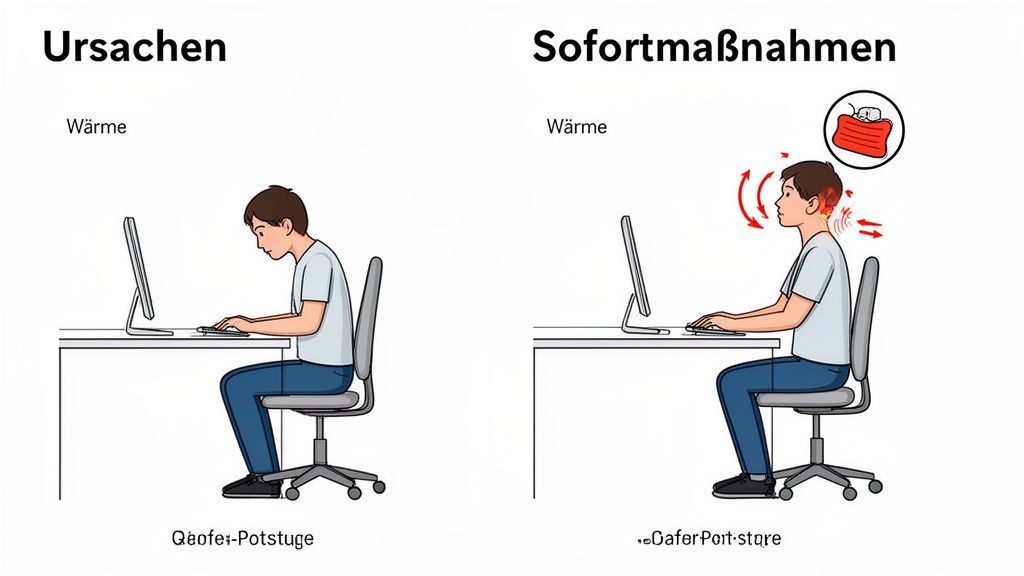
Neck tension is often a warning signal from the body. Prolonged sitting at a desk, a poorly adjusted monitor, or psychological pressure lead to constant tension in the neck and shoulder muscles. This tension reduces blood circulation and leads to painful muscle hardening.
Neck pain is widespread in Germany. A study by the Robert Koch Institute found that 45.7% of adults had experienced neck pain at least once in the last 12 months. This highlights the importance of understanding the triggers and actively counteracting them. You can find details on this in the results on the prevalence of back pain in Germany on statista.com.
Focusing on Immediate Relief
In case of acute pain, you need quick help to break the cycle of pain and tension. The following measures relax the muscles and stimulate blood circulation.
Simple home remedies can alleviate initial tension. Here is an overview of what you can do immediately:
Immediate measures for acute neck tension
Measure
Application
Effect
Heat application
Place a cherry pit pillow, hot water bottle, or take a warm bath for 15–20 minutes on the affected area.
Heat loosens muscles, stimulates blood circulation, and relieves pain.
Gentle movement
Carefully tilt your head from side to side, slowly rotate your shoulders. Important: No jerky movements!
Mobilizes muscles, prevents compensatory posture, and releases minor blockages.
Breathing exercises
Breathe deeply and consciously into your stomach, consciously letting your shoulders drop as you exhale. Repeat several times.
Reduces stress, which increases muscle tension, and promotes general relaxation.
Light self-massage
Gently massage the painful areas in your neck and shoulders with your fingers.
Loosens superficial hardening and locally stimulates blood circulation.
These first steps are often key to getting out of acute pain. They are quick to implement and offer noticeable relief.
Important: In case of acute pain, do not push your limits. Movements should feel good and not worsen the pain. Gentle mobilization is crucial.
For a more targeted approach, you can find further exercises against cervical spine syndrome in our article. These help you specifically strengthen and relax your muscles. The combination of immediate help and targeted exercises lays the foundation for long-term improvement.
Effective Exercises to Loosen Your Neck Muscles
Active movement is often the best answer to neck tension. Instead of remaining in a protective posture, targeted exercises help break the cycle of pain and tension. They stimulate blood circulation, loosen hardened areas, and restore mobility.
You can perform these exercises directly at your workstation. You don't need any equipment and only invest a few minutes.
Side Neck Stretch
This exercise targets the lateral neck muscles, which quickly tense up with a one-sided head posture.
Sit upright or stand straight. Your back is straight, shoulders relaxed. Slowly tilt your head to the right, as if you want to touch your shoulder with your ear.
Only go as far as you feel a pleasant stretch on the left side of your neck. Pain is a clear stop signal. To intensify the stretch, you can gently push your left hand towards the floor. Hold the position for 20 to 30 seconds and breathe calmly.
Then slowly return to the center and repeat the exercise for the other side. Two to three repetitions per side are ideal.
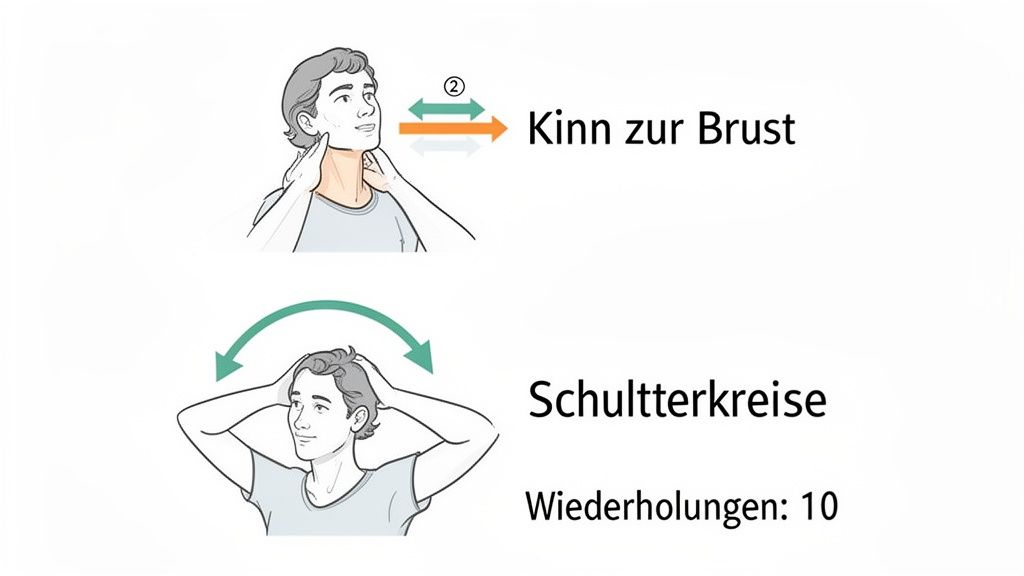
Chin to Chest
Constantly looking down at the screen or smartphone shortens the muscles in the neck area. This simple movement counteracts that.
Execution: Sit upright in your chair, both feet firmly on the floor. Slowly and controllably lower your chin towards your chest. Keep your back straight. You should feel a stretch along your cervical spine.
Duration: Stay in this position for 20 to 30 seconds and continue breathing steadily.
Repetitions: Afterward, slowly lift your head back up. Three to five repetitions are ideal.
Gentle Shoulder Circles
Tense shoulders are often the cause of pain radiating into the neck. With shoulder circles, you mobilize the entire shoulder girdle.
Posture: When standing or sitting, maintain an upright posture. Your arms hang loosely at your sides.
Movement: Slowly pull your shoulders up towards your ears, then move them in a large circular motion backward and lower them again. After ten repetitions, change direction and circle your shoulders forward.
For all exercises, the quality of execution matters, not the speed. Perform each movement slowly and consciously. Stop as soon as something hurts.
Head Rotation for More Mobility
This exercise improves the rotation of your cervical spine and loosens the muscles responsible for head turning.
Begin in an upright position, sitting or standing. Slowly turn your head to the right, as if you want to look over your shoulder.
Hold your gaze for a few seconds without your shoulders rotating with it. Then slowly return to the center and repeat the movement to the left side. Five to ten repetitions per side are a good guideline.
These exercises are a first step to relieve acute tension. If you want to delve deeper into the topic, you can find more neck exercises against neck pain in our guide to strengthen your muscles long-term.
Make these movements a regular part of your workday. You will quickly notice the difference.
Optimizing Your Workstation Ergonomically
Exercises help with acute tension. What helps against neck pain in the long run? The answer often lies at your desk. A poorly set up workstation forces your body into an unnatural posture for hours.
With targeted adjustments, you can achieve significant improvement. Adapt your workstation to your body, not the other way around. A neutral, relaxed body posture is the goal.
The Basics of Ergonomics
Your chair, desk, and monitor are the central components for an ergonomic posture. These three must be coordinated to relieve your cervical spine.
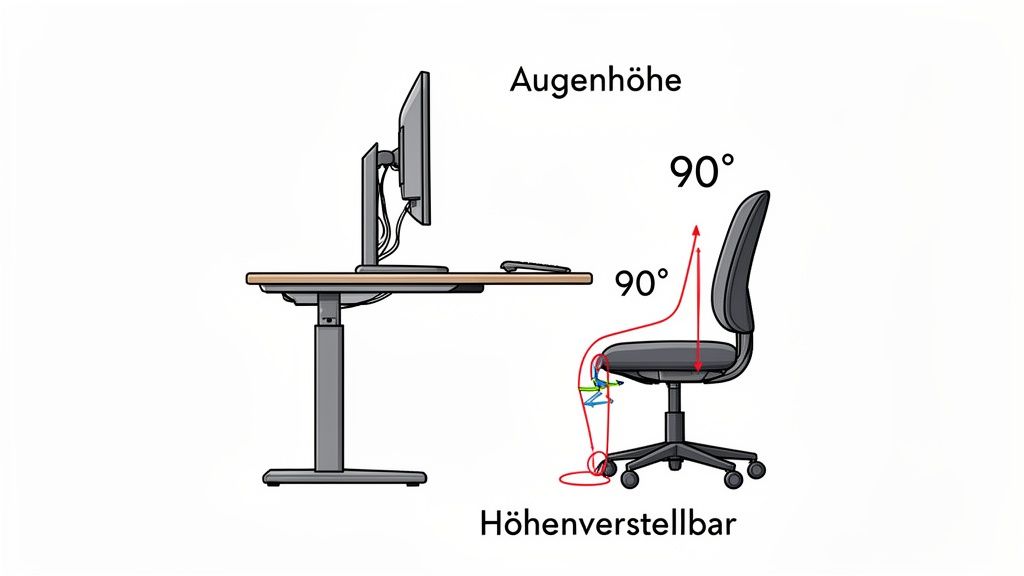
Start with the correct chair adjustment. Sit so that your feet are flat on the floor and your knees form an angle of about 90 degrees. Your thighs should be parallel to the floor. The backrest supports your lumbar spine.
Next is the desk height. Your forearms should rest loosely on the desk surface or armrests, with your elbows also forming an angle of about 90 degrees. Your shoulders should remain relaxed.
Correct posture at the workstation is a dynamic process. Regularly check your position and adjust it if necessary.
Monitor Positioning is Crucial
A poorly positioned monitor almost always leads to neck pain. If it's too low, you tilt your head forward. If it's too high, you hyperextend your neck.
The solution is simple:
Height: The top edge of your screen should be at or just below your eye level.
Distance: There should be about an arm's length distance between you and the monitor, i.e., 50 to 70 centimeters.
Angle: Position the monitor directly in front of you so you don't have to constantly turn your head to the side.
These adjustments prevent an unnatural head posture and reduce the strain on your neck. If you want to optimally set up your workstation, you can find more tips in our guide on how to set up your workstation ergonomically.
The Advantages of a Height-Adjustable Desk
Hours of rigid sitting are a major cause of neck problems. The most effective solution is a height-adjustable desk. It allows you to switch between sitting and standing. This dynamic way of working has several advantages:
Spinal relief: When standing, the load is distributed more evenly across the body, relieving the cervical spine.
Muscle activation: Every change in posture activates different muscle groups and prevents one-sided overload.
Improved blood circulation: Movement promotes blood circulation. This supplies your muscles better with oxygen and prevents tension.
Active measures such as movement and posture correction are important. An ergonomic workstation is key. A height-adjustable desk supports this approach by promoting optimal elbow and monitor alignment and reducing strain on the neck.
Start with short standing phases of 15 to 20 minutes per hour and gradually increase. Your neck will thank you.
Long-Term Strategies: How to Get Rid of Neck Pain Permanently
Acute relief is important, but for lasting pain-free living, you need more. Sustainable improvement can only be achieved through a consistent change in your habits. It's about proactively addressing the causes of tension.
A mix of exercise, targeted stress reduction, and lifestyle adjustments is key.
Regular Exercise and Targeted Strength Training
Remaining in one position for hours leads to muscular imbalances. A strong core and well-trained neck and shoulder muscles are your best protection.
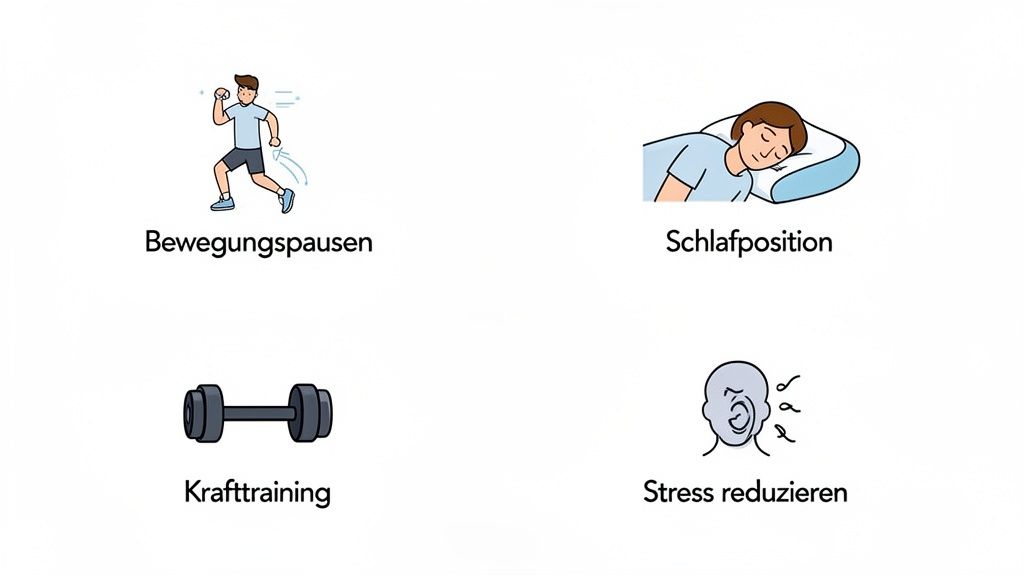
Integrate regular exercise breaks into your workday. The Pomodoro Technique is ideal for this: work concentrated for 25 minutes, then take a five-minute break. Stand up, stretch, or do some neck exercises.
In addition, targeted strength training is essential. Focus on exercises that strengthen your posterior shoulder and upper back muscles. This counteracts the typical "desk posture."
Rows with equipment or resistance bands: Strengthens the upper back and improves your posture.
Shoulder press: Strengthens the entire shoulder area and provides stability to your neck.
Planks: Trains your entire core musculature, which is essential for a stable spine.
Prevention is an active process. View exercise as a tool to become physically more resilient.
Stress Management and Mindfulness in Everyday Life
Psychological stress and neck pain are closely related. When stressed, you unconsciously pull your shoulders up. This permanent tension leads to hardening.
Effective stress management is therefore a central component if you are asking yourself what helps with neck tension. The following techniques will help you:
Breathing exercises: A few minutes of deep belly breathing can calm your nervous system and reduce muscle tension.
Meditation or mindfulness practice: With regular practice, you learn to recognize early signs of stress sooner and react more calmly.
Sufficient sleep: Your body regenerates during sleep. A consistent sleep routine and an ergonomic sleeping position are crucial for releasing tension.
Recognize and Change Bad Everyday Habits
Often, it's small, unconscious habits that lead to chronic neck problems. Analyze your daily routine and identify your personal "neck killers."
Typical examples include:
Clamping the phone between your ear and shoulder.
Working for hours with a laptop on the sofa.
Always carrying a heavy bag on the same shoulder.
Tilting your head far forward when reading on your phone.
As soon as you recognize these patterns, you can take targeted countermeasures. Use a headset for phone calls. Consciously maintain an upright posture when using your smartphone. Small changes in daily life often have the greatest long-term effect.
The following table provides an overview of how you can integrate various preventive approaches into your daily life.
Comparison of Preventive Strategies
This table compares preventive approaches by effort, frequency, and long-term benefit.
Strategy
Daily Effort
Long-term Benefit
Workplace Ergonomics
Low (one-time setup)
Very high
Regular Exercise Breaks
Medium (approx. 5–10 min/hour)
High
Targeted Strength Training
Medium (approx. 20–30 min, 2-3x/week)
Very high
Stress Management (e.g., meditation)
Low (approx. 10 min/day)
High
Mindfulness in Everyday Life
Low (continuous self-observation)
Medium to high
Each of these strategies contributes to prevention. You achieve the greatest effect by combining them.
When You Should See a Doctor
Most neck tensions are harmless. Often, your body simply signals that it's time for a break or more movement. With the right exercises and workstation adjustments, you can usually solve the problem yourself.
Nevertheless, it is crucial to know when the limits of self-help are reached. Some symptoms should be taken seriously, as they can indicate underlying causes.
Warning Signs You Shouldn't Hesitate About
Listen to your body. You should consult a doctor immediately if you experience the following symptoms:
Radiating pain: If the pain radiates from the neck into the shoulders, arms, or fingers, a nerve might be pinched.
Neurological deficits: Numbness, tingling, or sudden loss of strength in arms or hands are warning signs.
Severe headaches and dizziness: If unusually severe headaches, vision problems, or severe dizziness accompany your neck pain.
After an accident: Neck pain after a fall or traffic accident must always be examined.
Better to see a doctor once too often than once too seldom. Your health comes first. Seek professional advice if something doesn't feel right.
Further Reasons for a Doctor's Visit
In addition to acute warning signs, there are other situations in which a doctor's visit is advisable:
No improvement: If your neck pain does not improve or worsens after several days despite exercises and ergonomic adjustments.
Additional symptoms: If fever, chills, nausea, or unexplained weight loss occur.
Severe movement restriction: If you can barely turn or tilt your head.
A doctor can determine the exact cause. They can tell you what helps with neck tension in your specific case and prescribe targeted therapies.
What Else You Should Know About Neck Tension
Here you will find answers to frequently asked questions about neck tension.
How long does it take for neck tension to go away?
The duration is individual. Mild tension can often resolve within one to two days. Warmth and gentle movement are usually sufficient here.
Persistent tension that has built up over weeks can take several days or even weeks. The decisive factor is yourself: the more consistently you counteract with exercises and ergonomic improvements, the faster you will feel an improvement.
Important: If the pain lasts longer than a week or worsens, you should have it medically clarified.
What should you avoid with neck tension?
Do not remain in a protective posture. This only leads to other muscles cramping up and the problem becoming bigger.
What else you should avoid:
Sudden, jerky movements: This can overstrain the irritated muscles.
Cold: For muscular tension, warmth is better, as it stimulates blood circulation. Cold can further stiffen muscles.
Lifting heavy loads or carrying them unilaterally: This increases pressure on your neck and shoulder area.
Ignoring the cause: If you continue as before, the tension will always return.
Can stress cause neck pain?
Yes. Psychological stress is one of the most common triggers for a tense neck. When you are stressed, your body unconsciously tenses the muscles in your shoulder and neck area. You unconsciously pull your shoulders up.
This constant stress on the muscles leads to poorer blood circulation, which causes pain and hardening. The question of what helps with neck tension is therefore often also a question of proper stress management.
Does a special pillow help with neck tension?
A good, ergonomic neck pillow can be a worthwhile investment. Many tensions arise at night because the head is bent and the cervical spine is not in a neutral position.
A suitable pillow supports the area between the head and shoulders and prevents this bending. Which pillow is right for you depends on your sleeping position and the firmness of your mattress. Testing the pillow is often possible and recommended.
The best protection against recurring tension is an ergonomic workstation. At Deskspace, you'll find height-adjustable desks and ergonomic chairs that optimally support your body. Find the right solution for your workspace now at https://deskspace.de.